Ribbon Edge 8000

  • Robust Session Border Controller (SBC) option to protect communications traffic
  • Gateway options for telecom connectivity (T1/E1 and analog lines/stations)
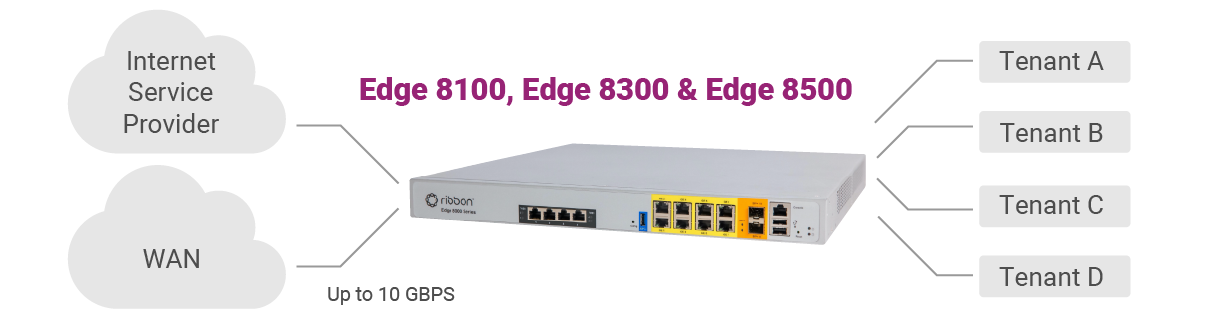
  • A high-performance, full-featured, multi-tenant, data router with up to 10 Gbps of throughput
  • High Availability (HA) option for SBC services and integration with Teams Survivable Branch Appliance (SBA)
  • Option RedHat OS variants of Edge 8300 & 8500 for FIPS 140-3 compliance
  • Hardware choices for both cost-effective and highly resilient deployment options
edge 8000
edge 8000 multi-tenant
edge 8000 high performance

Session Border Controller Services

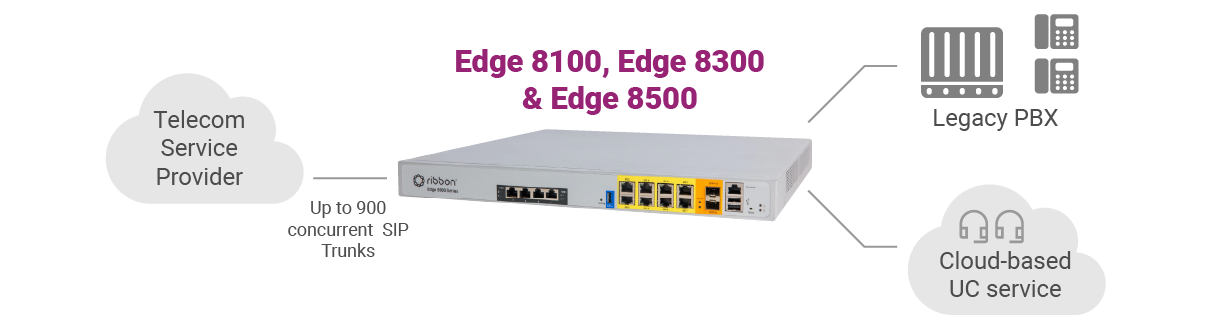
The Edge 8000 includes software space (VNF) to deploy Ribbon’s best-in-class SBC SWe Edge, providing best-in-class communications security. The Edge 8000 deployed with SBC SWe Edge software delivers:

  • Voice security (topology hiding, encryption, protection against Denial-of-Service attacks, and more).
  • High Availability (HA) deployment option
  • Interoperability with leading PBXs, cloud UC services, cloud contact center services, SIP endpoints, and SIP Trunking providers.
  • Certification with Microsoft Teams, Zoom Phone, Webex, Google Voice, and many other platforms.
  • Integration with Microsoft Teams Survivable Branch Appliance (SBA).
  • Advanced call routing features such as Active Directory/LDAP server routing integration and onboard call forking.
  • Powerful interoperability services including media transcoding and SIP header manipulation.

The SBC supports up to 1,000 (Edge 8100/ 8300) or 2,000 (Edge 8500) concurrent calls (SIP sessions), enough for 5,000 registered users. SBC services are incrementally licensed, making them cost-effective for very small deployments with seamless scalability to larger environments.

The Edge 8000 includes an intuitive user interface for the SBC SWe Edge, including ready-made templates for popular platforms and telecom providers.

edge 8000 branch-offfice-deployment

Analog & Digital Gateway

PRI – T1/E1

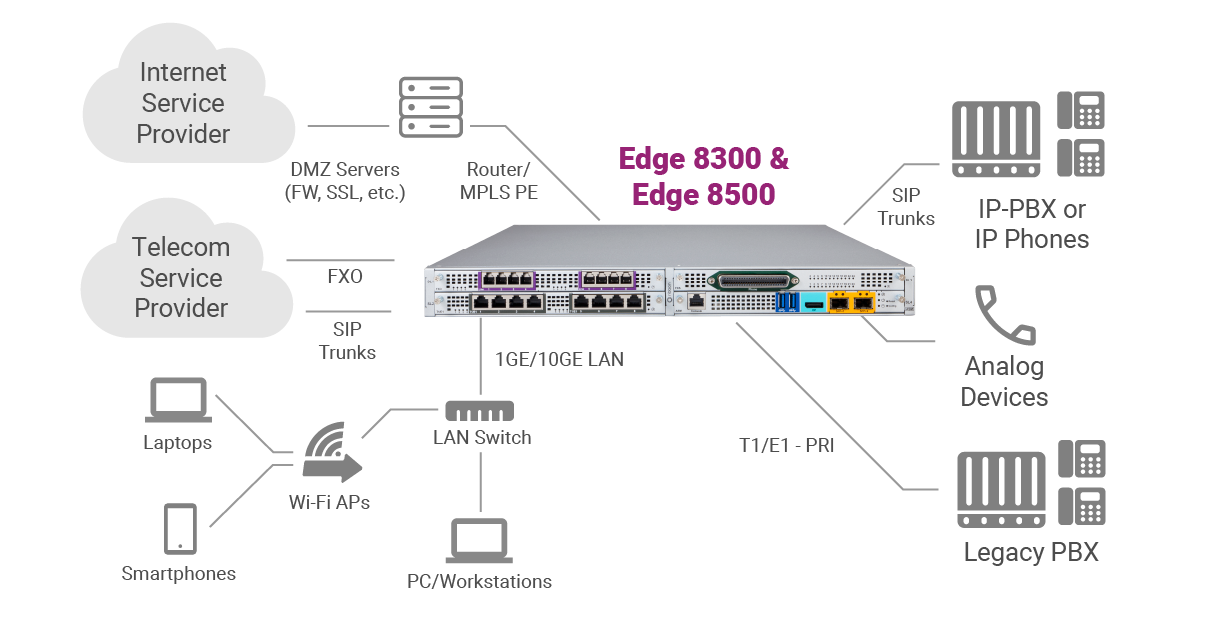
These ports can be used to interconnect with a telecom provider via T1/E1 or as gateway ports to integrate a legacy PBX or contact center that does not support SIP Trunks. 

Edge 8500 offers modular gateway cards that support 8 PRI ports per card. Up to 4 cards can be deployed per Edge 8500 appliance, for up to 32 T1/E1 ports. These ports offer a total of 736 (T1) or 960 (E1) bearer channels.

Edge 8300 is equipped with 4 PRI ports for T1/E1 connectivity.  These ports offer a total of 92 (T1) or 120 (E1) bearer channels.

Analog Lines (FXO)

FXO ports are frequently used as a backup if the primary IP connection is disrupted. Additionally, the FXO ports can also be used to interconnect legacy devices, such as overhead paging.

The Edge 8500 offers a modular FXO gateway card that supports up to 8 loop-start analog lines. Up to 2 cards can be deployed to support up to 16 FXO ports in total

The Edge 8300 can be purchased with 2 FXO ports (and 22 FXS ports) to provide direct access to traditional analog lines.

Analog Stations (FXS)

FXO ports to provide traditional analog station connectivity for analog phones, fax machines, elevator phones, door phones, etc. This enables organizations to retain existing investments in analog devices while maintaining existing business processes.

The Edge 8500 offers modular FXS cards that support up to 24 FXS ports per card. Up to 4 cards can be deployed to support a total of 96 FXS ports. 

The Edge 8300 can be purchased with 24 FXS ports or a configuration of 22 FXS and 2

Up to 10 Gbps Router

The Edge 8100, 8300, and 8500 provide a proven routing platform that delivers scalable, cost-effective IP routing. The platform’s modern software-based architecture purposely divides resource up into a control plane and a data plane. The control plane runs independently of the data plane component and the routing software has native multi-queue support to distribute the load across multiple CPU cores.

Key services include:

  • Border Router: Multi-homing with BGP – enabling multiple links to a single service provider or resilient connections to multiple service providers for redundancy, reliability and path diversity.
  • VPN Concentrator and Site-to-Site VPN: Secure point-to point connections between multiple sites, data centers, and public/private clouds.